
Which products fall under which EPR scheme?
Each Extended Producer Responsibility (EPR) scheme covers products or packaging with similar uses or common characteristics.
To identify the EPR schemes that apply to your products, it is often easiest to start with the product itself. The examples below illustrate the most common situations.
The approach is practical: start with the actual product or packaging and identify the corresponding EPR scheme.
Here are a few examples to help you get started
Waste Electrical and Electronic Equipment (WEEE)
These are products that operate using electricity or contain electronic components.
Examples:
- Laptop, monitor, printer → Waste Electrical and Electronic Equipment (WEEE) EPR scheme
- Electric drill, electric lawn mower → Waste Electrical and Electronic Equipment (WEEE) EPR scheme
- Charging station or vending machine → Waste Electrical and Electronic Equipment (WEEE) EPR scheme
- Solar panel installed on a building → Photovoltaic Panels EPR scheme
For example:
A drill sold in a DIY store falls under the Waste Electrical and Electronic Equipment (WEEE) EPR scheme, even if it is used by a professional.
Batteries
This includes all products designed to store or supply energy.
Examples:
- AA or AAA batteries sold at supermarkets → Batteries EPR scheme
- Electric bike or scooter battery → Batteries EPR scheme
- Industrial batteries (forklift, inverter) → Batteries EPR scheme
For example:
An electric scooter falls under the Waste Electrical and Electronic Equipment (WEEE) EPR scheme.
Sports and Leisure Goods
They include equipment intended for sports or recreational activities.
Examples:
- Soft mobility equipment (bicycles, skateboards, etc.) → Sports and Leisure Goods EPR scheme + Batteries EPR scheme (if a battery is included)
- Non-electric mobility → Sports and Leisure Goods EPR scheme
- Camping equipment → Sports and Leisure Goods EPR scheme
- Sports equipment (excluding non-technical textiles) → Sports and Leisure Goods EPR scheme
- Outdoor toys for children → Toys EPR scheme
For example:
A ball, a tent or a pool table falls under the Sports and Leisure Goods EPR scheme, while a tricycle falls under the Toys EPR scheme.
DIY and gardening equipment
These are tools and equipment designed for DIY projects or outdoor maintenance.
Examples:
- Powered DIY and gardening equipment → Powered DIY and Gardening Equipment EPR scheme
- Electric DIY and gardening tools → Waste Electrical and Electronic Equipment (WEEE) EPR scheme
- Hand tools for DIY and gardening → DIY and Gardening Equipment EPR scheme
For example:
A robotic lawn mower falls under the Waste Electrical and Electronic Equipment (WEEE) EPR scheme, a gas-powered lawn mower under the Powered DIY and Gardening Equipment EPR scheme, and a wheelbarrow under the DIY and Gardening Equipment EPR scheme.
Everyday consumer products
These are goods intended for everyday use.
Examples:
- Plastic bottles, shipping cartons → Packaging EPR scheme
- T-shirts, sheets, shoes → Textiles, Household Linen and Footwear (TLC) EPR scheme
- Dolls, building sets → Toys EPR scheme
Everyday consumer products generally fall under a single EPR scheme, but their packaging may also fall under the Packaging EPR scheme.
Building and construction products
These are products used for the construction, renovation or fitting-out of buildings.
Examples:
- Windows, doors, plasterboard → Building Products and Materials (PMCB) EPR scheme
- Sink, toilet, tap → Building Products and Materials (PMCB) EPR scheme
- Outdoor furniture, outdoor shelters → DIY and Gardening Equipment EPR scheme
- Sofa, desk, chair → Furniture EPR scheme
For example:
Kitchen units in a fitted kitchen may fall under both the Furniture and Building Products and Materials (PMCB) EPR schemes, depending on their characteristics.
Specific or hazardous products
They require special handling at the end of their useful life.
Examples:
- Paint, solvents, fertilisers → Specific Diffuse Waste (DDS) EPR scheme
- Car or bicycle tyre → Tyres EPR scheme
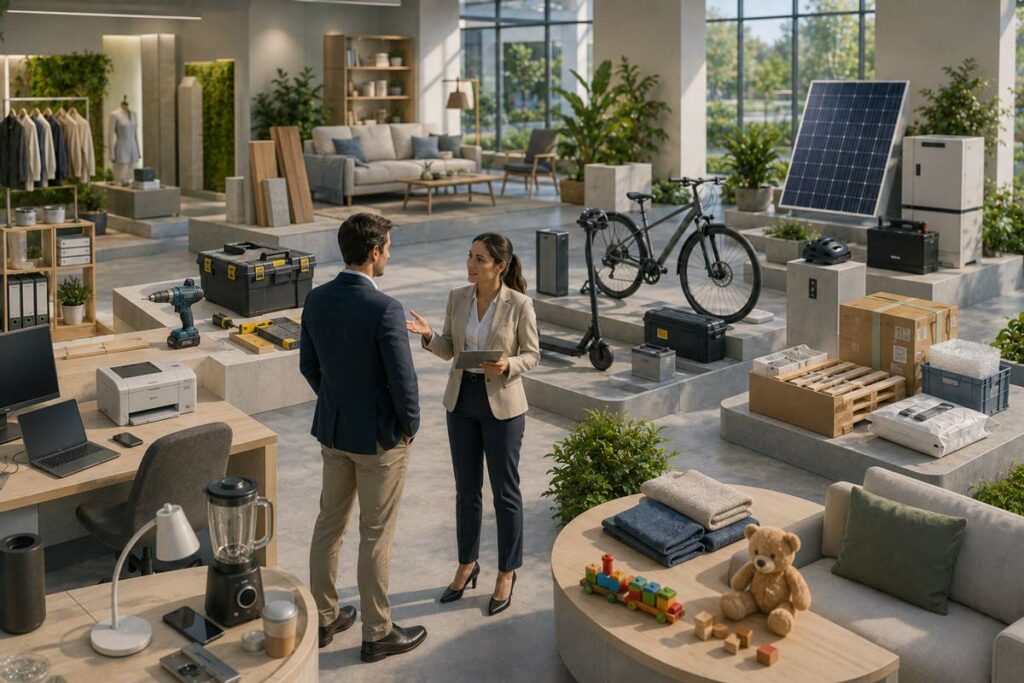
Common cases involving multiple EPR schemes
These situations are common when a product consists of multiple components or is sold in packaging.
In practice, many products may fall under several EPR schemes:
- Smartphone → Waste Electrical and Electronic Equipment (WEEE) EPR scheme + Batteries EPR scheme + Packaging EPR scheme
- Battery-powered electric lawn mower → Waste Electrical and Electronic Equipment (WEEE) EPR scheme + Batteries EPR scheme
- Packaged photovoltaic panel → Photovoltaic Panels EPR scheme + Packaging EPR scheme
These situations are common and should be anticipated before the product is placed on the market.
How can you make sure you have identified the right EPR schemes?
To avoid any mistakes:
- Identify the product and its primary function (e.g., power tool, furniture, toy…)
- Identify any elements that may fall under another EPR scheme (battery, electrical component, packaging, etc.)
- Check how the product is marketed (intended for consumers, professionals or both; sold on its own or with packaging, etc.)
- Consult the documentation provided by producer responsibility organisations (PROs) when classification is unclear.
An EPR representative can also support you in classifying your products and centralising your EPR obligations.
Key Takeaways
- A single product may fall under one or more EPR schemes.
- Practical examples are essential to avoid mistakes.
- Combined products may fall under several EPR schemes.
Correctly classifying your products from the outset saves time, helps ensure compliance and makes your EPR reporting more reliable.

